Field notes
Why You Can't Sleep When You Camp (and the Fix That Isn't a Better Pad)
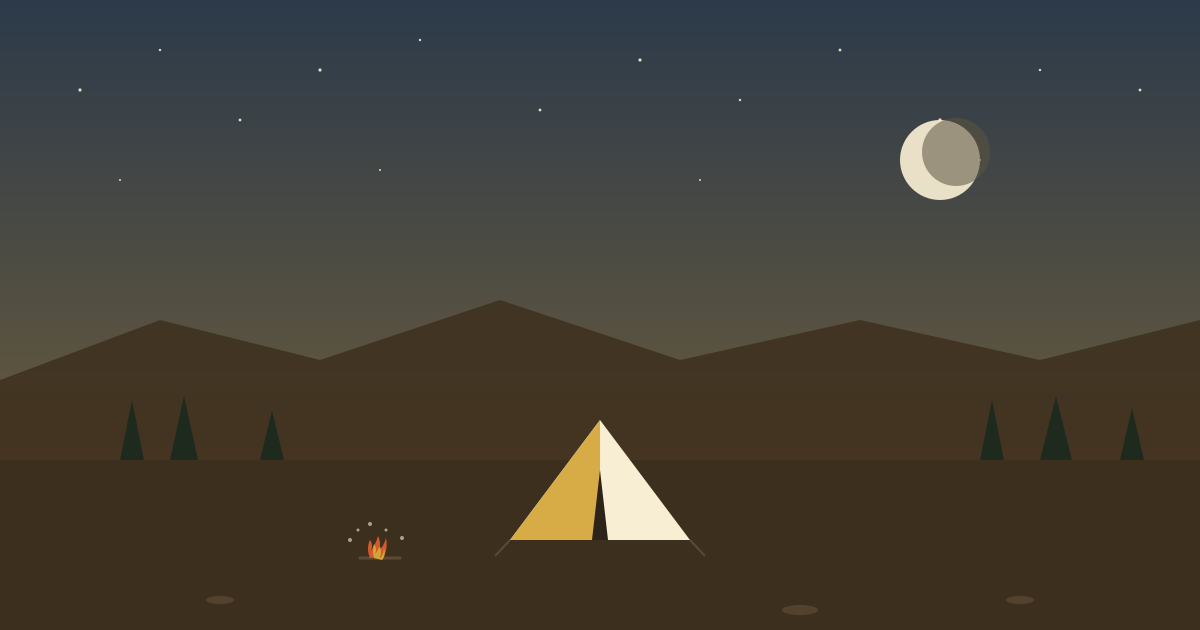
The silence after I turned the engine off was the first thing that startled me—not the absence of noise, but the sudden weight of it pressing against my eardrums. California’s Sierra foothills swallowed the rumble of the car, and for a long moment I just stood there, boots crunching pine needles, listening to my own heartbeat. I pitched my tent by the last smear of dusk light, careful to find flat ground this time, but by midnight the cold had seeped through my bag like a slow leak. Somewhere in the dark, another camper’s snore drifted from a distant site, and I lay rigid, wondering why my own body refused to surrender.
For years, I blamed myself. Bad camper, I thought. I tried every sleeping pad on the market—inflatable, foam, even a cot. Bought a $400 bag. Wore a balaclava. And still, somewhere between midnight and dawn, I’d wake up shivering or stiff, forced to sit up and wait for the sun.
Here’s what I learned after hundreds of nights on the ground: you can’t sleep camping because your body wasn’t built for it. Not a gear problem. A physics problem.
The Ground Steals Your Heat
Your thermostat works overtime when you’re lying on dirt. The ground is a massive heat sink. Even in summer, soil temperature lags behind air—often by 10-15°F. When you press your sleeping bag against earth or pine needles, it compresses the insulation, creating a thermal bridge. That’s why you wake up with a cold back inside a warm bag.
A good pad helps. But here’s the dirty secret: even a thick air pad can’t fully decouple you from the ground’s thermal mass. The R-value on your pad was tested in a lab on a perfectly flat surface—not on a rocky campsite with air moving underneath. In real conditions, you lose 20-30% of that insulation.
Pressure Points Are the Real Enemy
Your mattress at home distributes weight across a soft, uniform surface. The ground doesn’t. Even on flat dirt, you’ll find small rocks, roots, and lumps that dig into hips, shoulders, knees. Your subconscious never fully relaxes—it’s constantly micro-adjusting to avoid pain. That’s why you wake up tired.
I once camped in a lush meadow that looked like a lawn. By 2 a.m., I was awake from a pebble that felt like a marble under my hip. I moved; it found another spot. This isn’t bad luck—it’s the nature of sleeping on a planet that hasn’t been graded for your back.
The 3 a.m. Wake-Up Is a Feature
Almost every camper I’ve talked to knows the 3 a.m. ritual. You wake up cold, stiff, or just… awake. Your body has hit its lowest core temperature—circadian low—and the ground has sapped enough heat to trigger a stress response. Cortisol spikes, heart rate picks up, and suddenly you’re fully alert. This isn’t insomnia. It’s survival instinct.
The fix isn’t a better pad. It’s not a thicker bag. It’s getting off the ground.
The Glamping Solution
I resisted glamping for years. Thought it was cheating. But after a friend dragged me to a yurt with a real bed, I slept through the night for the first time in a decade of camping. The bed was on a platform—elevated from the ground. Mattress was full size. Heat loss? Gone. Pressure points? None.
That experience changed how I think about /camping. The goal isn’t to suffer—it’s to connect with nature. And you can’t connect when you’re exhausted.
Check out my [glamping sleep setup guide] if you want to build a comfortable outdoor bed from scratch. Or skip the gear arms race and book a [first-night in a yurt]—trust me, the sleep quality is transformative.
What Actually Works (Besides a Bed)
If you’re not ready to abandon tent camping, here are the only things that have ever helped me:
- Double up on pads. Stack a closed-cell foam pad under an inflatable. The foam blocks ground conduction better than air alone.
- Use a bag liner. Silk or fleece adds 5-10°F and prevents sweat from chilling you.
- Pre-warm your sleeping bag. A Nalgene of hot water at your feet reduces the initial heat drain.
- Camp on leaf litter. A six-inch layer of dry leaves is surprisingly insulating.
But honestly? None of these beat a real bed. I’ve tried them all. The moment I stepped into a cabin with a mattress, I realized I’d been fighting the wrong enemy.
The Fix Is Elevation
My recommendation: For your next trip, book a cabin or yurt. Look for properties that mention “real bed” or “raised platform.” The difference isn’t subtle. You’ll wake up at sunrise feeling rested, not wrecked.
Browse our [cabins] and [yurts] sections—both list properties with proper beds. I’ve stayed in dozens, from rustic log cabins with hand-tied quilts to modern yurts with memory foam. Every one of them gave me a sleep that no tent ever could.
Final Thoughts
You’re not weak. You’re not a bad camper. You’re a human being who evolved sleeping on soft, warm surfaces—not cold dirt. The 3 a.m. wake-up isn’t your fault. It’s the ground’s fault.
Let yourself off the hook. Next time, choose a bed. You’ll thank yourself when you wake up at sunrise—not at 3 a.m.
For more on camping sleep science, see [can’t sleep camping] and our [glamping sleep setup guide].
Ready to try a bed? Explore [cabins] and [yurts] with real mattresses.
Frequently asked questions
Why can't I sleep when camping?
The two main reasons are thermoregulation issues (your body struggles to maintain core temperature on the ground) and pressure points from hard, uneven terrain. A sleeping pad helps but often isn't enough.
How does sleeping on the ground affect body temperature?
The ground conducts heat away from your body rapidly, especially below 40°F, causing your core to cool and disrupting deep sleep. Even in summer, ground temp can be 10-15°F cooler than air.
What's better than a thick sleeping pad for camping sleep?
A real bed on a platform, like in a cabin or yurt. The elevation and insulation from the ground eliminate conductive heat loss and pressure points. That's why /glamping is the fix.
Is it normal to wake up at 3 AM while camping?
Yes—it's extremely common. The 3 AM wake-up is often due to your body hitting a thermal low point or a pressure point causing micro-awakenings. It's not your fault; it's the ground.
Can better gear solve camping sleep problems?
Gear helps but has limits. A high-R-value pad and proper bag can manage temperature, but uneven ground still creates discomfort. For reliable sleep, elevating off the ground is the real fix.
What should I do if I keep waking up cold while camping?
Check your pad's R-value (aim for 4+ for 3-season, 6+ for winter), use a sleeping bag liner, and wear a hat. But consider switching to a cabin or yurt with a real bed for guaranteed warmth.
Why do I sleep better in a tent vs. a cabin sometimes?
Some people prefer the coziness of a tent, but objectively, a cabin's bed eliminates ground heat loss and pressure points. If you're waking up a lot, a cabin is almost always better.